Over the years, we have noticed that some presses—particularly long-established publishers that are continually growing and adding to their publishing programs—are operating more than one website. Sometimes it’s because they have one or more significant imprints on their list. Or they have limited control over making changes to their main website and so it is easier to launch an entirely new site to accommodate an important new aspect of the publisher’s list. Or, they may have purchased another press that already had an existing site. Or they have two sides to their publishing program: adult and children’s, for example.
We have developed several websites for publishers who have come to us with more than one existing site, and who are looking for a more elegant and efficient way to structure their web presence. What we’ve learned along the way is that amalgamating sites, data feeds, content, and content management systems allows the press more flexibility and efficiency in managing their site, makes for a much better user experience, and saves money, time, and effort.
Let’s look at a few ReaderBound projects that have risen to this challenge. Each method is slightly different, working with the press team to consider a solution that works best for them.
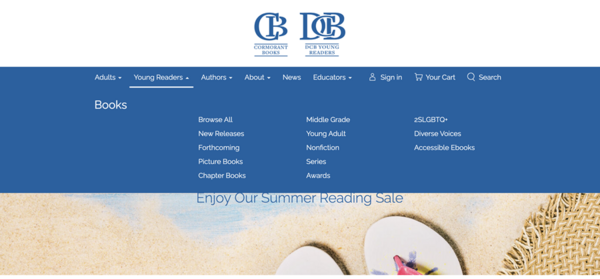
Cormorant Books and DCB Young Readers are an adult press and children’s imprint. They were previously operating two separate sites that were fully manually controlled and did not support direct sales to readers. Their ReaderBound site brought the DCB imprint onto the same website as Cormorant. However, each side of the press has their own landing pages, navigation menus, and discovery options. The brands are together, but the books are still distinct.
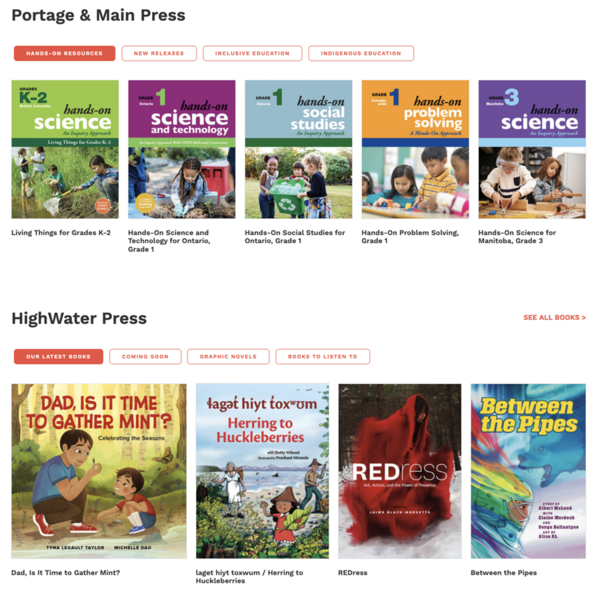
A slightly different approach comes from Portage & Main Press & HighWater Press. Portage & Main publishes a wide range of educational resources. Its imprint HighWater Press publishes stories by emerging and established Indigenous writers. However, since both Portage & Main and HighWater books and resources reach many of the same target audiences, their products are integrated throughout the site while still maintaining a level of distinct discoverability.
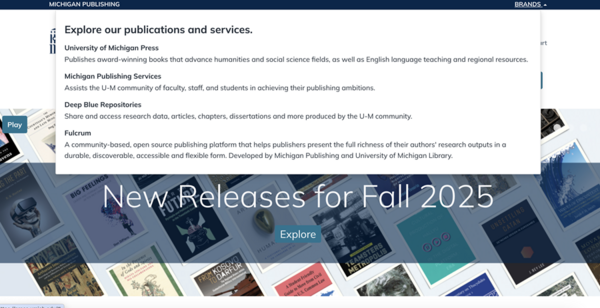
Yet another method comes from the University of Michigan Press and Michigan Publishing Services (MPS). When we first started working with Michigan, they were presenting their extensive list across four separate websites. We consolidated those down to two—one for the press and one for Michigan Publishing Services—in order to maintain a necessary distinction and separation between the two divisions. (Everything that the press publishes goes through a peer review process, whereas Michigan Publishing Services does not rely on peer review. Rather, it is a professional publishing bureau serving faculty members across the university as well as from other institutions.)
The new websites for the press and MPS are presented to the user as separate web properties, accessible via a master menu that carries across the header area on both sites. However, the two sites are published from a single ReaderBound install. This means the Michigan team manages both within the same content management system, with flexible permissions for users to access one or both sites. The design was also shared, with variations where needed. Overall, it was a much more cost-effective and elegant solution than building two entirely separate websites. And while there are two different “shops” for the two different sites, they still use the same fulfillment and ecommerce solution.
Working with each new publisher gives us a chance to develop a custom solution that truly meets the press’ needs. The books you publish are all different—so why should your websites be the same?