Our ReaderBound webinar series continues with a session on book categorization.
“Categorization is like a press’s DNA,” says ReaderBound’s Director of Technology Doug Plant. Join us as we take a deep dive into publishers’ lists in our fall webinar on book classification.
Learn why good book classification is the key to unlocking discovery in this webinar for publishers. And come on a tour of best practices for categorizing your books via Thema, BISAC, custom subjects, and specialty schemas.
The recording is available to view now.
We’re also pleased to share a written recap below. This is just a brief overview, so if this is an area of interest please watch the video for lots of specific examples and advice!
The reason book classification is more important than ever now is just because of the sheer volume of books in the marketplace. The estimates vary, but there are 30 to 50 million titles available right now. In an environment where there are so many books competing for reader attention, it’s even more important to classify your books in a meaningful and thoughtful way. In the online space in particular, classification plays a critical role in the visibility of the work and in the reader's ability to find the right book. We also care about categorization because it's a way of adding meaning to the information; to reflect the importance of the work and what the author has to say. Really thoughtful categorization is also a way to open up new browsing and search opportunities. At Readerbound that's something we particularly focus on.
We're going to look at a few different types of classification schemes.
BISAC
If you're working in Canada or in the States, BISAC (Book Industry Standards and Communications) is the convention for book categorization. Over the last 10 or 15 years the BISAC classification scheme has become a lot more rich. There's a lot more nuance and support for different categories than there used to be and it continues to develop year over year.
BISAC is first and foremost a bookstore facing scheme. Its original function was to provide a signal to book retailers as to where a particular book should be shelved in the store. It has value in lots of different online channels as well and certainly in online retail. It's a wonderful device for the industry, but it has some limitations. The best practices for BISAC are that you choose a primary code—the subject that the book most closely relates to—and you can add supporting codes to that. The recommendation is a maximum of three codes, which provides you with a very effective baseline for categorizing your work and especially for the retail trade. In other spaces, such as education or libraries where they’re looking for curriculum linkages or other thematic references, you may need other ways to categorize your books.
Thema
The next major classification scheme is Thema. Thema is a powerful additional classification scheme for books that is not that widely used, but we're seeing more of it now. The thing that's significant about it is that it's a truly international scheme. It's already been translated into 25 different languages. It's a very robust scheme that has about 3,000 core subject classifications across about 20 top level categories. Along with those subject classifications it has several subject qualifiers that allow you to lay additional detail on top of that subject classification, such as language, place or interest.
Thema is becoming more widely used in major online retail. Amazon uses it quite extensively outside of North America. It has a role to play and as time goes on, we can expect more.
Custom Subjects
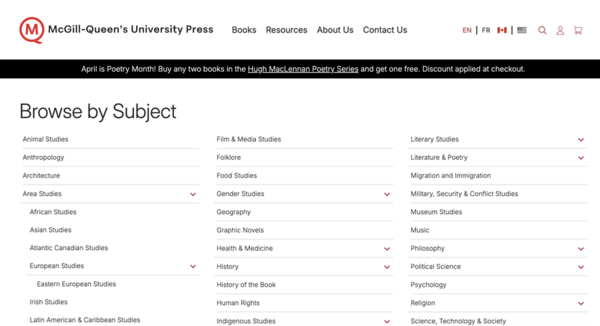
Next, let’s talk about custom subjects. At Readerbound, most if not all of our client sites make use of custom subject schemes on their websites. On your own site, you can decide what the structure is that you want to use to present your work and you can do it in a way that is really meaningful both to your list and to the readers that you're trying to engage with.
For example, this is a custom subject scheme from McGill-Queen’s University Press that has three levels to it.
Another example is from Playwrights Press. A lot of their sales are to community theatre groups and to university and college theatre programs where buyers come to the website with a specific structure for the play in mind. They might have for example two female and six male players in their community theater group and they’re looking for a play that is a good fit for that group. Cast structure becomes a really important organizing device for the list, so we set up a custom subject scheme that reflects that particular interest.
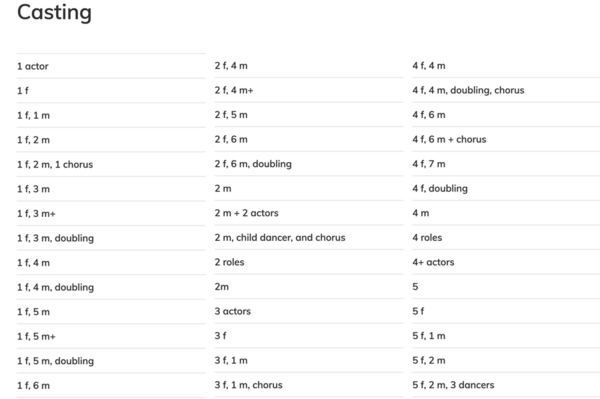
A custom scheme is a wonderful way for readers to find their way into your catalogue if they have a particular interest, not just in one subject, but in a specific aspect of a subject. You can lead them right there. You can also use it to leverage search behaviour on your website. This is something you can only do on your own website, where you have the most control over how your books are presented.
Specialty Schemas
Even if you're working with a single classification scheme at the moment, one important takeaway is that there are many more ways to classify books. There's a whole landscape of specialty schemas out there.
For example, University of Michigan Press have now begun to incorporate a custom schema called Homosaurus, a classification scheme that's connected to LGBTQIA+ terms and themes. It comes from the library sector in the US and is starting to get traction in the marketplace.
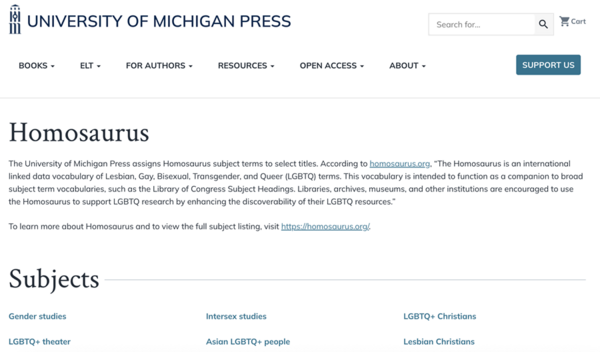
When we see these kinds of specialty schemes, it’s a different way of trying to accommodate some of the important nuance and detail that's quite specific to different categories and lists. Every team at every press like knows their lists so intimately. That's partly what we see reflected in the custom subject schemes that we're working with on client sites. You're seeing that resident expertise within the publishing team really coming to the forefront, and you’re allowing readers to follow their interests to the right part of your catalogue for them.