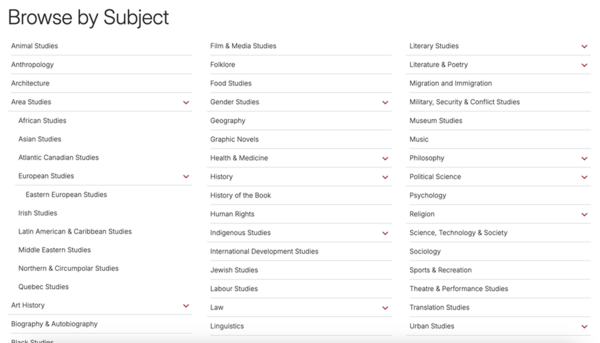
Within the friendly confines of their own websites, many presses like to step outside of BISAC or other industry-standard subject schemes and categorize their list using custom subjects. A custom subject scheme is specific to your press, and it allows you a level of flexibility and meaning on your own site that you won't have anywhere else in the supply chain.
You can find plenty of examples across ReaderBound sites, such as McGill-Queen's University Press, Portage & Main, and Playwrights Canada Press.
If you've never used a custom subject scheme before, the first step is to sit down and sketch it out—that is, to try and create a categorization scheme that can be used across your entire list. If this is something you want to explore, or if you are thinking about renovating an existing set of custom subjects, here are a few ideas to help you get started.
1. Keep it real. One of the best things about custom subjects is that you can use them to describe your books in the way you want to, and with categories that are rich in meaning for your list. For example, if you are publishing regional nonfiction, you can work those specific regional or local references right into your custom categories so that readers can easily find books about a specific place. Similarly, if your list is deep in a specific area or areas, you can create additional subjects or sub-categories to support that focus. This makes it easier for readers to follow their individual interests to the right corner of your catalogue.
2. Don't ask your subject index to work too hard. Because there are few constraints on your custom scheme, it's tempting to make it overly complicated. Try to make yours as concise and elegant as possible, where you avoid duplication of terms and where there is an internal logic that helps the overall subject index be clear, intuitive, and easy for the user to scan. One way to do this is to incorporate sub-categories beyond your main headings. We build sites with two-level or evenl three-level custom schemes that make it easier for readers to navigate, but also better accommodate areas of real depth within the list.
You can also use multiple subject schemes, where each type of categorization serves a different purpose and/or reflects a distinct aspect of your list. For example, along with a list of custom subject classifications, Playwrights Canada Press uses a second custom scheme to categorize its drama titles by cast structure.
3. Think about your reader. Just as they provide a distinctive classification of your list, custom subjects can also be used to provide powerful signals to readers by incorporating terms or references that are meaningful to them. Librarians or educators, for example, may respond to different terms, or ways of categorizing work, than would a general reader. For example, Portage & Main Press uses a "Big Ideas" subject scheme for K-12 educators which links each book to specific curricular themes.